OTN forum - “Pro”
w00t :-D
Yesterday I got my “Pro” medal for 500 points on OTN Forums
I’d been intending to post a grumpy rant about OTN recently, but maybe I’ll postpone that for a few days now ;)

w00t :-D
Yesterday I got my “Pro” medal for 500 points on OTN Forums
I’d been intending to post a grumpy rant about OTN recently, but maybe I’ll postpone that for a few days now ;)
Two new blogs of note :
Both are well worth a read & following.
Watch out if you are using init blocks in your RPD. We hit a bug (#9019374) recently that caused BI Server (10.1.3.4) to hang.
The init block in question should have returned a date to update a repository variable, but because of badly-written SQL and abnormal data in the source table actually returned a null value. BI Server evidently didn’t like this null being inserted somewhere where it shouldn’t have and understandably logged :
The Critical Patch Update Pre-Release Announcement for October has been published. The pre-release is advance notice of the affected software prior to release of the quarterly Critical Patch Update. It is published on the Thursday prior to the patch releases (which was postponed by a week because of OOW).
It looks like if you’re running OBIEE 10.1.3.4.0 or 10.1.3.4.1 through OAS 10.1.2.3.0/10.1.3.4.0/10.1.3.5.0 then you should check back next Tuesday 20th for details.
The latest point release of Oracle Business Intelligence Applications, 7.9.6.1, has been released and is available for download from here (direct link to download).
The version.txt reports the version as:
Build: 7.9.6.1.100609.2038 Release Version: Oracle Business Intelligence Applications 7.9.6.1 Package: 100609.2038
No updated documentation library yet through, so can’t nosey through the release notes. The docs that come with the download are labelled 7.9.6 and dated April 09 so don’t look like they’ve been updated either.
OBIEE comes with a very useful usage tracking feature. For information about it and how to set it up see these links:
Usage Tracking captures the logical SQL of queries in a column called QUERY_TEXT in the table S_NQ_ACCT. However, out of the box this column is defined as 1k (1024 bytes) long. In some situations this will limit its usefulness because the text will be truncated if necessary when it’s inserted.
This is a supplemental post to this one describing how to set up a VUser in LoadRunner to test OBIEE. It’s various notes that I made during the development but which aren’t directly part of the step-by-step tutorial. They’re not necessarily vital for recording scripts, but observations and explanations that should be helpful when working with LoadRunner and OBIEE.
It’s no use running a load test if the load you think you’re applying isn’t actually being applied. To validate the test you compare what happens on the server when the scenario is manually performed with what happens with it’s from a VUser and hopefully the same behaviour is observed.
My two earlier posts (here and here) detail the difficulties I had with LoadRunner (now called HP Performance Center). After a bit of a break along with encouragement from knowing that it must be possible because it’s how Oracle generates their OBIEE benchmarks I’ve now got something working. I also got a useful doc from Oracle support which outlines pretty much what I’ve done here too.
In essence what you do - and what the Metalink document 496417.1 states - is you use the Web (HTTP/HTML) protocol with URL-mode.
A new blog from James Morle, who I don’t know but from other bloggers sounds well respected, and describes himself thus:
Since it’s been nearly ten years since I wrote my book, Scaling Oracle8i, I thought it was about time that I started writing again. I thought I would start with the new-fangled blogging thing, and see where it takes me. Here goes.
He’s got a really interesting post on “red flags” to look for in diagnosing performance problems in Oracle: Spotting the Red Flags (Part 1 of n).
SQL Developer v2.1 Early Adopter was released yesterday.
Bit of an odd one this. Oracle 11g database, a user’s password has expired. But when I try to change it, I can’t: [sourcecode language=“bash”] $sqlplus MYUSER/oldPW@oraDBServer
SQL*Plus: Release 10.2.0.1.0 - Production on Wed Sep 23 07:57:41 2009
Copyright (c) 1982, 2005, Oracle. All rights reserved.
ERROR: ORA-28001: the password has expired
Changing password for MYUSER New password: Retype new password: ERROR: ORA-01017: invalid username/password; logon denied
Password unchanged [/sourcecode]
(Updated 12th Oct 09)
Here’s a list of the OBIEE benchmark documents published by Oracle:
| Benchmark | Date | Source document |
| 1 - IBM System x3755 | Sep-07 | |
| 2 - HP DL380 G4 | Sep-07 | |
| 3 - Sun T2000 | Sep-07 | |
| 4 - Sun SPARC Enterprise T5440 | Aug-09 | |
| 5 - Sun SPARC Enterprise T5440 | Oct-09 |
Collecting the numbers into one table gives this: 
Based on the details in the documents I think these were all against OBIA’s Service Analytics schema & dashboards/reports.
Interesting to note the side-by-side comparison in benchmark 3 (Sun T2000) of two servers, in one case both running BI and Presentation Services and in the other having the two components separate. It appears to highlight the benefit that clustering provides in making the best use of resources.
Here’s a list of the OBIEE benchmark documents published by Oracle:
Production cluster is 2x BI Server and 2x Presentation Services, with a BIG-IP F5 load balancer on the front.
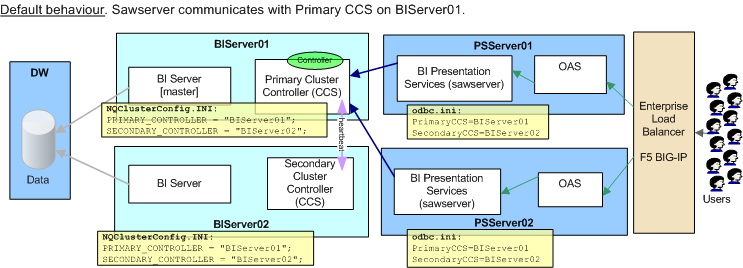
Users started reporting slow login times to BI. Our monitoring tool (Openview) reported that “BIServer01 may be down. Failed to contact it using ping.”. BIServer01 cannot be reached by ping or ssh from Windows network.
nqsserver and nqsclustercontroller on BIServer01 was logging these repeated errors:
[nQSError: 12002] Socket communication error at call=send: (Number=9) Bad file number
A new version of the web browser Opera was released recently. Several years ago I used Opera and may even have paid for it IIRC. Then Firefox came along, and the “it’s not IE” excuse was lost for Opera. Not that I mind IE too much nowadays but at the time it was atrocious. Since then I’ve revisited Opera each time a new release has come out, but nothing has impressed me enough to ditch Firefox (and nowadays Google Chrome).
Bringing together in one place all of the script syntax that I’ve found so far for using with OBIEE’s AdminTool.exe /command
Details and examples on usage in the following blogs (where I compiled the commands from):
DON’T TRY THIS AT HOME!
I would only recommend this for read-only purposes such as generating the metadata dictionary or consistency check.
* OpenOnline DSN [user [password]] - Opens the online repository. NB can’t edit properties without checking out objects first, and no way to do that from script.
There’s an undocumented feature in AdminTool.exe that you can use the /command switch with a text file containing scripted commands to make changes to an RPD file (or create a new one).
It’s undocumented and UNSUPPORTED so be careful using it.
Some good details in these blog posts, especially Erik’s which has a good list of syntax.
I’m intrigued to know how the original posters figured out the commands available, if it’s undocumented… :)
Kudos to the My Oracle Support blog for taking the time to respond to my to my comment about searching for Metalink 3 SRs throwing an error.
In essence, if you previously used Metalink 3 you must use https://support.oracle.com. If you use https://metalink.oracle.com/ then you’ll hit the problems I did.
ML3 SR’s are not supported on https://metalink.oracle.com/CSP/ui/index.html. This front end is used for support on legacy server technology, middleware including BEA, and EBusinessSuite
Another way of keeping up with what’s going on in the obiee world, add this RSS feed of del.icio.us obiee tags to your reader. It may be less “current” (because people might discover and bookmark ‘old’ pages), but it’s another tool in the armoury :)
If you want an aggregated RSS feed of OBIEE / Oracle related blog postings try this one.